
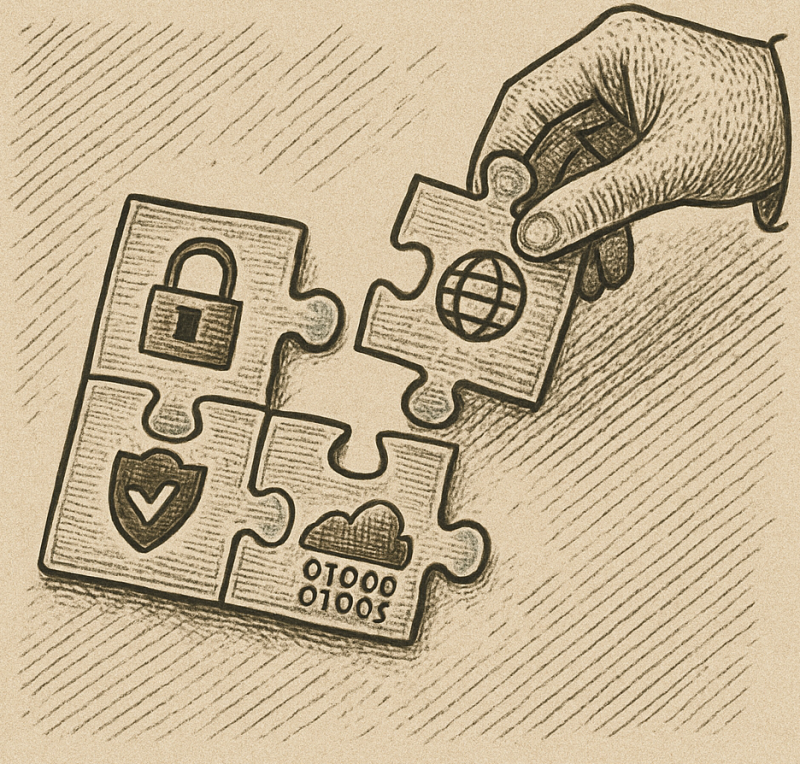
Building a robust Information Security Program requires more than just good intentions and reactive measures. Organizations must establish foundational infrastructure, governance structures, and comprehensive policies that work together to create a security-aware culture. The key is to implement systems that not only protect assets today but also provide the documentation and processes necessary to demonstrate compliance and continuous improvement over time.
Foundational Infrastructure
Four critical infrastructure components form the backbone of any effective security program:
- A ticketing system serves as the central repository for tracking security incidents, vulnerability remediation, access requests, and change management activities.
- A secure source code repository provides version control, audit trails, and access management for all software development activities (including software that processes sensitive data).
- Published security and privacy policies, standards, and procedures must be readily accessible to all stakeholders, providing clear guidance on expected behaviors and security requirements.
- An InfoSec calendar that provides a well-defined schedule for critical information security related activities throughout the year.
These elements create the solid foundation that auditors and regulators can and will scrutinize when assessing your organization’s security posture.
Governance Structure
Effective security governance requires two distinct but complementary groups working in concert.
- An IT Security Committee, composed of executive and senior leadership, should meet at least annually to make strategic IT security decisions, allocate resources, and publish an annual InfoSec Road-map that aligns security initiatives with business objectives.
- A SecOps group, whether a dedicated team or a cross-departmental virtual group, should meet regularly to discuss tactical security operations, coordinate incident response, and evaluate progress against the InfoSec Road-map.
This dual-layer approach ensures that security receives both executive attention and operational follow-through.
The Security Calendar
A shared security calendar, visible to both the Security Committee and SecOps team, is essential for maintaining program momentum and ensuring nothing falls through the cracks. This calendar should pre-schedule periodic IT security meetings, internal and external audits, audit preparation activities, penetration tests, documentation reviews and updates, annual security incident management drills, and regular disaster recovery exercises. Each calendar event should link to corresponding tickets in the tracking system that capture preparation activities, findings, remediation efforts, final reports and post-activity cleanup. This results in an auditable trail that demonstrates due diligence and continuous improvement.
Change Management and Audit Readiness
Change Management deserves special emphasis as it represents a critical intersection between operational needs and audit requirements. Every change ticket must contain sufficient detail to allow future auditors to understand what was changed, why it was changed, who authorized it, and what testing validated the change. Status updates to tickets must be timely and accurate, creating a real-time record of change progression from request through implementation to closure.
Similarly, commit messages and pull requests in source code repositories must provide clear context and rationale, as these records may very well also be also examined during security assessments and compliance audits. Poor documentation practices in these areas can result in audit exceptions that lead to lost business and expensive, time-consuming remediations.
Essential Security Policies
A comprehensive Information Security Program requires a well-organized set of security and supporting policy documents covering all aspects of organizational security. Such documentation includes:
- Information Security Roles and Responsibilities – Defines security accountability across all organizational levels and functions.
- Security Document Maintenance – Establishes policies for the regular review, update, approval and version control of security related documentation.
- User Access Management – Governs the life-cycle of user access from provisioning through periodic review and account de-provisioning.
- Authentication & Authorization – Specifies requirements for identity verification and access control mechanisms.
- Data Classification – Establishes categories and handling requirements based on data sensitivity and criticality.
- Data Protection – Defines technical and procedural controls for protecting data at rest, in transit, and in use.
- Privacy – Addresses the collection, processing, storage, and disposal of personally identifiable information.
- Monitoring – Establishes requirements for logging, monitoring, and alerting on security-relevant events.
- Risk Management – Defines processes for identifying, assessing, treating, and monitoring security risks.
- Vulnerability Management – Governs the identification, assessment, prioritization, and remediation of security vulnerabilities.
- Incident Response and Management – Establishes procedures for detecting, responding to, and recovering from, security incidents.
- Network Security – Defines requirements for securing wired and wireless public and private network infrastructure, segmentation, and traffic filtering.
- Endpoint Management and Security – Governs the security configuration and management of endpoint devices such as servers and containers.
- Workstation Management and Security – Specifies security requirements for end user computing devices.
- Application Security – Establishes secure development lifecycle requirements and application security.
- Cloud Security – Addresses security responsibilities, requirements for and policies that govern cloud service utilization.
- Physical Security – Defines controls for protecting physical assets and facilities that house IT assets (including data).
- Vendor, Sub-processor and Subcontractor Security – Establishes security requirements for third-party relationships.
- Supply Chain Security – Addresses risks associated with hardware and software supply chains.
- Communications Security – Governs secure communication channels and encryption requirements.
- Security Training – Defines security awareness and role-based training requirements.
- Acceptable Use – Establishes expectations for appropriate use of organizational resources.
- Business Continuity and Disaster Recovery – Defines processes for maintaining operations during disruptions.
- Regulatory Compliance – Addresses adherence to applicable laws, regulations, and contractual obligations.
- Audit and Assessment – Establishes processes for internal and external security assessments.
- Change Management – Governs the process for requesting, approving, implementing, and documenting changes.
- Configuration Management – Defines requirements for maintaining secure baseline configurations.
- AI Security – Addresses risks and controls specific to artificial intelligence systems and applications.
- IoT Security – Establishes security requirements for Internet of Things devices and ecosystems.
Conclusion
An effective Information Security Program is built on solid infrastructure, clear governance, comprehensive policies, and meticulous documentation practices. The integration of ticketing systems, source code repositories, governance bodies, and a well-maintained security calendar creates a framework that not only protects organizational assets, but also demonstrates compliance and continuous improvement to auditors and stakeholders. By implementing these critical components, organizations can move from reactive security postures to proactive, mature programs that anticipate threats and systematically reduce a broad range of risk over time.
